How Enterprise Leaders Approach Rising AI Costs
Rethinking Enterprise AI Economics
Series: Part 2 | Part 3 | Part 4 | Part 5
A 5-Part Guide for Enterprise Leaders
Part 1
The next phase of enterprise AI is knowing how to optimize costs.
As AI moves from experimentation to production, controlling costs has become a priority for enterprise leaders. Organizations building on OpenAI and Anthropic are increasingly looking for ways to reduce their AI bills. According to Laura Bratton and Catherine Perloff in The Information ("How AI Customers Are Lowering Their Anthropic and OpenAI Bills"), some organizations have reduced AI costs by up to 90% through a combination of prompt optimization, prompt caching, adopting open models for appropriate workloads, and more efficient AI delivery.
The range of approaches available to enterprise leaders is expanding quickly. Recommendations now include everything from governance policies and prompt optimization to open models, inference optimization, and infrastructure improvements. Rather than asking whether to use AI, organizations are increasingly asking how to maximize business value while keeping AI spending predictable and sustainable.
These approaches all reduce AI costs, but they do so in different ways. Some reduce AI consumption. Others improve application efficiency. Others change the underlying economics of AI delivery. Increasingly, enterprises are also looking beyond individual AI requests to optimize entire AI systems: coordinating models, tools, workflows, and infrastructure to improve both cost and performance. Each approach involves different trade-offs, different stakeholders, and different long-term implications.
To help make sense of this evolving landscape, we've grouped these approaches into three broad categories.
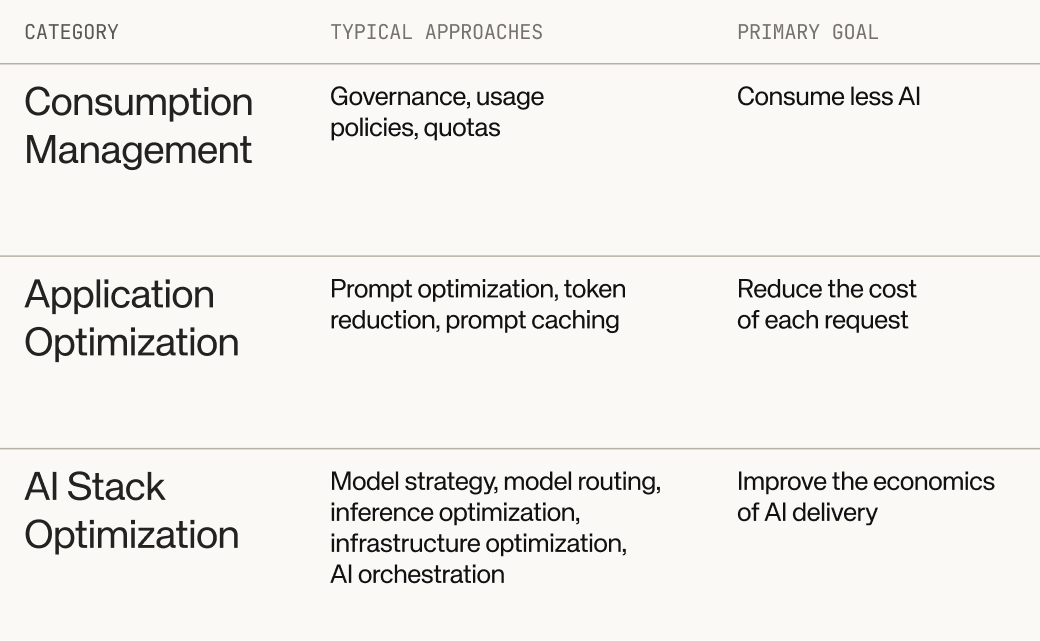
While all three approaches have an important role to play, they differ in how they reduce costs.
Consumption Management
Organizations establish governance policies, usage limits, approval workflows, or chargeback models (allocating AI costs to the business units that use them) to ensure AI resources are used appropriately. Premium models may be reserved for business-critical applications, while less demanding workloads are directed toward lower-cost alternatives. Organizations may also set spending limits, require approval for high-cost use cases, or allocate AI costs back to individual business units to encourage greater accountability.
Recent enterprise surveys suggest that monthly AI budgets now range from roughly $250 per employee in some organizations to several thousand dollars for engineering, data science, and other high-value technical roles. According to SemiAnalysis in "Our Conversations with Enterprises on Token Spend," many organizations are also reserving premium frontier models for the workloads that truly require them while making lower-cost models the default for everyday use.
These measures can often be implemented quickly while supporting broader governance objectives such as security, compliance, responsible AI use, and budget oversight. They also provide organizations with greater visibility into how AI is being used across the business, helping identify opportunities to eliminate unnecessary or inefficient usage.
Their primary objective, however, is straightforward: reduce AI spending by reducing AI consumption.
Application Optimization
With this approach, developers optimize prompts, remove unnecessary context, cache responses, batch requests, and redesign workflows to reduce token usage and minimize calls to language models.
These techniques reduce the cost of individual requests while preserving application functionality. For organizations already operating AI applications at scale, relatively small improvements in efficiency can translate into significant savings.
Application optimization improves the efficiency of the application layer, but it does not fundamentally change the underlying economics of AI delivery.
AI Stack Optimization
This next approach focuses on the AI stack itself. Rather than reducing consumption or optimizing applications, organizations are increasingly examining the technology used to deliver AI. This is where some of the most significant changes in enterprise AI economics are occurring.
AI stack optimization consists of two broad areas: model strategy and AI delivery strategy. Model strategy determines which models an organization uses. AI delivery strategy determines how those models are deployed, optimized, and operated in production. Once organizations decide where frontier models, open models, or model routing make sense, they must also determine how those models will be delivered—through proprietary APIs, managed open-model platforms, self-managed deployments, or integrated enterprise AI platforms. They must also evaluate the inference software and infrastructure used to serve those models. Together, these decisions define an organization's AI delivery strategy.
Model Strategy
Model strategy examines which models are best suited for different workloads. Rather than defaulting to a single frontier model, organizations are increasingly evaluating where open models provide sufficient capability and where premium models continue to deliver meaningful business value. Recent advances in open models have narrowed the performance gap for many enterprise use cases while significantly reducing costs, prompting organizations to reassess long-held assumptions about when proprietary models are necessary. At the same time, leading proprietary model providers are responding with lower prices and more cost-efficient offerings, making model economics an increasingly competitive battleground. Many organizations are also introducing model routing, directing different requests to different models based on cost, latency, and performance requirements rather than relying on a single model for every task.
AI Delivery Strategy
AI delivery strategy encompasses two closely related areas: inference optimization and infrastructure optimization.
Inference optimization focuses on serving models more efficiently. While model quality often receives the most attention, the software used to deliver those models has become an important factor in enterprise AI economics. Advances in inference engines have significantly improved GPU utilization, reduced latency, increased throughput, and lowered the cost of serving AI without changing the underlying model. As a result, two providers offering the same model can deliver very different cost, performance, and scalability, making inference optimization an increasingly important consideration when evaluating AI platforms.
Infrastructure optimization examines the compute environment itself. Decisions about GPUs, networking, orchestration, workload placement, storage, and system architecture all influence cost, performance, resilience, and scalability.
Together, inference optimization and infrastructure optimization determine how efficiently AI models are delivered in production. As organizations move from experimentation to production, AI delivery strategy is emerging as one of the most significant opportunities for reducing costs without compromising capability.
A Framework for Enterprise AI Costs
Most organizations will employ some combination of all three approaches. Governance helps manage consumption. Application optimization improves software efficiency. AI stack optimization changes the underlying cost structure of AI itself.
While all three approaches are important, the remainder of this series focuses on AI stack optimization because it represents one of the fastest-moving areas of enterprise AI. Advances in model strategy, inference software, infrastructure, and AI delivery are fundamentally changing the economics of AI, creating new opportunities to reduce costs without compromising capability.
Over the next four articles, we'll examine each of the AI stack decisions in more detail:
- Part 2: Model Strategy: Evaluating Models for Enterprise Workloads.
- Part 3: Inference Optimization: Why the delivery layer matters.
- Part 4: Infrastructure Optimization: Why infrastructure has become a strategic differentiator.
- Part 5: AI Delivery Strategy: How organizations should evaluate the growing range of options for deploying and operating enterprise AI.
Understanding these approaches provides a practical framework for evaluating AI cost strategies. As enterprise AI continues to mature, competitive advantage will increasingly come not only from access to powerful models, but from making better decisions about how AI is selected, delivered, and integrated into efficient AI systems.
Sources
- Laura Bratton & Catherine Perloff. How AI Customers Are Lowering Their Anthropic and OpenAI Bills. The Information
- Crystal Huang, Joey Brookhart, and Dylan Patel. Our Conversations with Enterprises on Token Spend. SemiAnalysis, June 30, 2026.
You can't prompt-engineer your way past a 200 Gbps network cap.

You can't prompt-engineer your way past a 200 Gbps network cap.