
Built to Build AI: Rethinking Infrastructure for the Age of AI
Most enterprises are running modern AI workloads on infrastructure designed for a different era. The AI ecosystem has advanced rapidly, but the cloud environments powering it are still rooted in virtualization primitives built for web services: virtual machines, hypervisors, shared kernels, container orchestration, multi-tenant inference queues.
Each of these was a reasonable choice for the workloads of its time. Stacked together under modern AI demand, they produce predictable failure modes: jitter, noisy neighbors, fragmented GPU allocation, poor multi-node scaling, and inference costs that climb faster than usage.
Using a more efficient model helps, but it's only half the story. As model capabilities converge, advantage in enterprise AI is moving from the model to the system delivering it. The foundation underneath is where that system either works or doesn't.
Why Legacy Cloud Architecture Doesn't Fit
AI workloads place fundamentally different demands on compute than traditional web applications. They need sustained, high-throughput processing, tight coordination across hardware, and deterministic execution.
Conventional cloud environments were not built for any of that. Hypervisors and shared kernels introduce jitter that production AI workloads can't tolerate. Software-defined networks and container orchestration add latency variability at every hop. Multi-tenant queues create noisy-neighbor problems that flow directly into cost per token. And virtualization layers fragment GPU allocation, preventing efficient MIG partitioning and leaving expensive compute sitting idle.
At small scale, these constraints are manageable — but at production scale, they compound.
What Changes in Production
In sustained, real-world use, infrastructure behavior becomes the primary determinant of system performance and, more importantly, cost.
As AI deployments scale, execution efficiency becomes an increasingly important determinant of cost. Overhead from orchestration layers, idle GPU capacity, and scheduling inefficiencies all flow directly into the bill. Variability that's tolerable in development becomes operationally disruptive in production. And shared infrastructure introduces real concerns around data handling, performance interference, and compliance that enterprise workloads can't ignore.
What matters in practice isn't the feature list. It's how the system behaves under sustained demand: how efficiently resources are used, how consistently workloads execute, how much control teams have over their environment.
What AI-Native Infrastructure Actually Requires
Addressing this gap requires more than incremental improvement on top of existing systems. It requires rethinking the foundation.
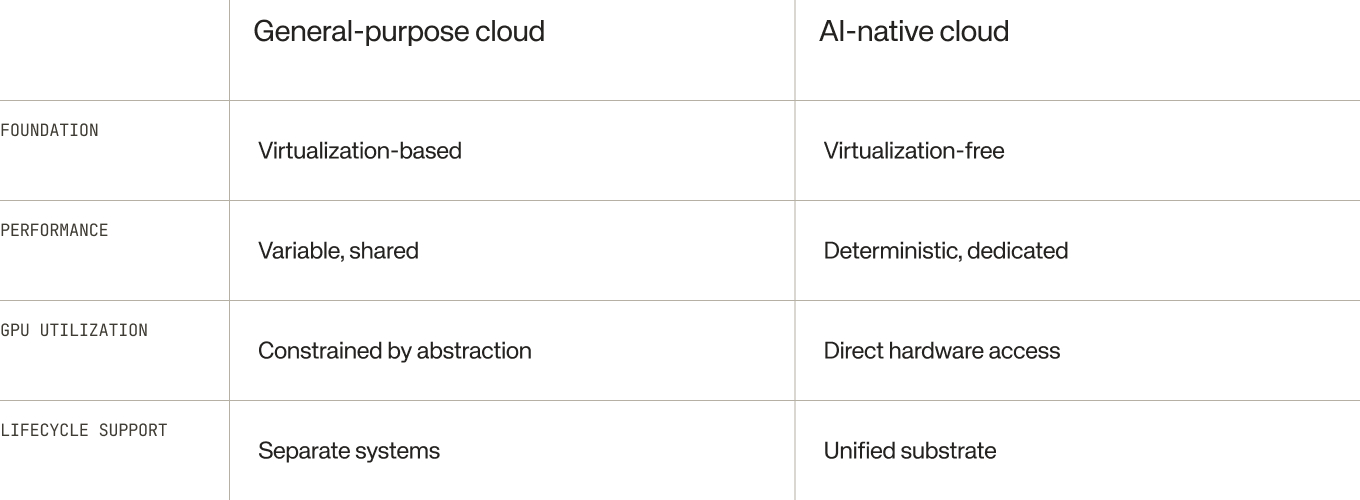
The principles are straightforward. Workloads need direct access to underlying compute, without unnecessary virtualization in the path. Execution environments need to be deterministic, not approximate. Infrastructure needs to be dedicated by default, not shared as the norm. And the AI lifecycle — from training to fine-tuning and serving — needs to run on a unified substrate rather than separate systems stitched together.
"The result is less distance between workload and hardware, and a system whose behavior under load is predictable rather than approximate."
What an AI-Native Foundation Looks Like
Many AI platforms were built by adapting traditional cloud architectures to support AI workloads. As AI adoption scales, a new generation of AI-native infrastructure is emerging, designed specifically around the demands of model training and inference.
One approach is to reduce unnecessary layers between software and hardware, allowing systems to make more efficient use of underlying compute resources. This can include dedicated GPU resources, workload isolation, and scheduling approaches optimized for AI workloads.
Rather than treating training, fine-tuning, and inference as separate environments, AI-native architectures increasingly seek to manage them as parts of a unified system.
The practical effect is higher utilization, lower overhead, and consistent performance from development through production — without the fragmentation that defines most enterprise AI infrastructure today.
The Real Constraint
The limiting factor in enterprise AI deployment is increasingly the infrastructure underneath it. Systems designed for the previous generation of computing introduce inefficiencies that grow more pronounced as workloads scale.
The shift required isn't a better feature set on existing platforms. It's a different foundation.
You can't prompt-engineer your way past a 200 Gbps network cap.

You can't prompt-engineer your way past a 200 Gbps network cap.