Building an Enterprise AI Model Strategy
Rethinking Enterprise AI Economics
Series: Part 1 | Part 3 | Part 4 | Part 5
A 5-Part Guide for Enterprise Leaders
Part 2
Organizations are moving beyond model selection toward model strategy
In the early days of generative AI, model choice was relatively straightforward. Organizations looking to build AI applications typically selected the most capable frontier model available. OpenAI and Anthropic established an early lead in performance, making closed frontier models the default choice for enterprises seeking the highest-quality results.
Today, that decision has become considerably more nuanced. Much of this change has been driven by the rapid maturation of open-weight models, which are now challenging the long-held assumption that closed models are the only viable choice for enterprise-grade AI.
According to Stanford HAI's AI Index Report 2026, the performance gap between closed and open-weight models has narrowed significantly. As of March 2026, the leading closed model outperformed the leading open model by just 3.3%, reflecting the rapid progress of open models and their growing suitability for many workloads. Meanwhile, closed model providers have responded by introducing lower prices, smaller models, and more cost-efficient offerings, making AI economics increasingly important across both ecosystems.
At the same time, enterprise AI has moved beyond experimentation. Organizations are now deploying AI across customer service, software development, operations, knowledge management, and internal productivity, with different applications placing different demands on cost, performance, latency, security, and deployment.
The result is that enterprises now have more choices than ever, not only between open and closed models, but within each category. This expansion of choice changes the nature of the decision itself. Enterprise leaders are increasingly asking a different set of questions. Rather than simply identifying the most capable model, they are evaluating when closed models justify their additional cost, where open models provide sufficient performance, and how different models fit different workloads. In other words, organizations are moving beyond model selection toward model strategy. This shift represents one of the most important changes in enterprise AI today.
From Model Choice to Model Strategy
At a high level, the conversation is often framed as a choice between open and closed models. While that is a useful starting point, the underlying business question is much broader.
Every organization deploying AI must balance several competing priorities. They want the highest possible quality, but they also need predictable costs. They want flexibility without creating unnecessary operational complexity. They want to protect sensitive data while avoiding long-term dependence on a single vendor.
These trade-offs become increasingly important as AI moves from occasional experimentation to production systems serving thousands of employees or millions of customer interactions.
This shift is changing the way enterprises think about model selection. A model strategy is not simply a preference for open or closed models. It is a structured approach to deciding which models should be used for which workloads, under what conditions, and with what trade-offs. Rather than asking, "Which model is best?", enterprise leaders are increasingly asking, "Which model is best suited to this particular task?"
That decision depends on the complexity of the workload, the business value of the output, the scale of deployment, governance requirements, and the overall economics of AI delivery. For many organizations, the result is no longer a single model standard, but a portfolio of models aligned with different business needs.
When Closed Models Make Sense
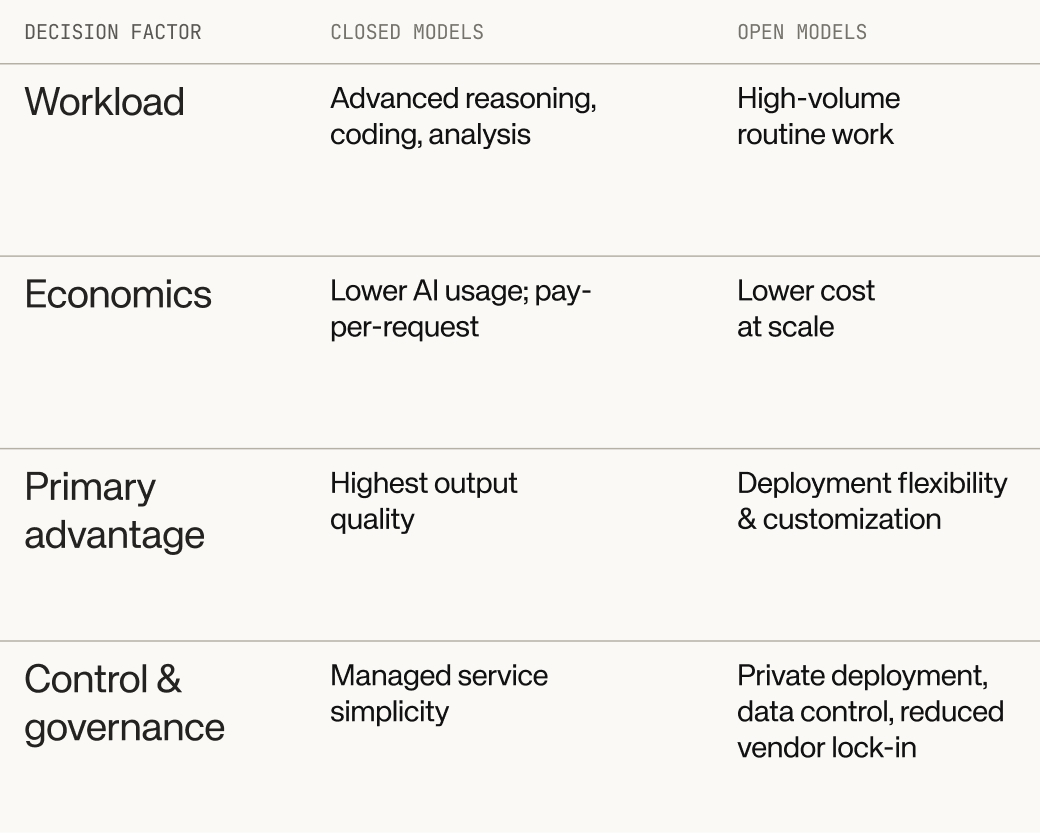
Despite the rapid progress of open models, closed frontier models continue to offer important advantages. For organizations tackling highly complex reasoning, advanced software development, sophisticated analysis, or other mission-critical applications, frontier models often continue to deliver the strongest overall performance. When small improvements in accuracy, reasoning, or code quality have a meaningful impact on revenue, risk, or customer experience, paying a premium for the best available model can be justified.
The question, then, is not whether closed models are worth the cost, but where they deliver the greatest value. Rather than standardizing on a single premium model for every application, many organizations reserve frontier models for workloads that require the highest levels of reasoning or accuracy while directing routine tasks to lower-cost alternatives.
When Open Models Become the Better Economic Choice
The economics begin to change as AI usage scales. Organizations processing large volumes of documents, customer interactions, software development tasks, internal search, or other routine workloads find that open models deliver sufficient capability at substantially lower cost.
Open models also provide greater flexibility. Organizations can choose from a growing ecosystem of providers, reduce vendor lock-in, and select deployment options that best align with their performance, governance, and cost requirements. For enterprises with strict regulatory or data governance requirements, this flexibility can become a significant strategic advantage.
As model performance continues to improve, open models have become an increasingly attractive economic choice for organizations deploying AI at scale.
The Growing Complexity of the Open Model Ecosystem
The growing adoption of open models has created a new operational challenge. Rather than relying on a single AI provider, organizations increasingly confront a rapidly evolving ecosystem of models, inference providers, routing systems, evaluation frameworks, governance tools, development frameworks, and deployment options. These components often evolve independently, making the open AI stack increasingly fragmented and operationally complex.
Many organizations are introducing model routing, allowing applications to automatically select the most appropriate open model for each request based on complexity, latency, cost, and performance requirements. Matching workloads to the right model improves efficiency while reducing overall AI costs.
Organizations should also evaluate how well models integrate with the broader AI development ecosystem. Compatibility with tools such as Cursor, Claude Code, LangChain, and enterprise agent frameworks can reduce switching costs, accelerate adoption, and improve developer productivity.
The result is that success with open models depends on more than choosing the right model. Organizations must also navigate an increasingly fragmented ecosystem while maintaining cost, performance, governance, and operational efficiency.
Beyond Model Selection
Choosing an open model is only the beginning. Organizations must still decide how those models will be deployed, managed, optimized, and integrated into the broader AI stack.
Two providers may offer access to exactly the same model while delivering very different levels of cost, performance, scalability, and reliability. Those differences arise not from the model itself, but from the software and infrastructure used to serve it.
As the open model ecosystem matures, the AI delivery layer becomes increasingly important. The challenge is no longer simply accessing a capable open model, but delivering that model efficiently, reliably, and economically at enterprise scale.
That is the focus of the next article in this series, which explores why the AI delivery layer has become one of the fastest-moving areas of enterprise AI economics, and why the same model can cost significantly less to run depending on how it is delivered.
Sources
- Stanford Institute for Human-Centered Artificial Intelligence (HAI). AI Index Report 2026.
You can't prompt-engineer your way past a 200 Gbps network cap.

You can't prompt-engineer your way past a 200 Gbps network cap.