
Why the AI Delivery Layer Matters
Rethinking Enterprise AI Economics
Series: Part 1 | Part 2 | Part 4 | Part 5
A 5-Part Guide for Enterprise Leaders
Part 3
How inference shapes the economics of AI
In Part 2, we explored how open-weight models have rapidly closed the performance gap, making them a practical choice for an expanding range of enterprise AI workloads. Rather than replacing closed models outright, organizations are increasingly adopting a multi-model strategy, which means using frontier models where their capabilities justify the cost while deploying open models for high-volume, production-scale workloads where cost, control, and efficiency matter most. But once a model is chosen, another strategic decision emerges: How will that model be delivered in production?
It’s reasonable to assume that the same AI model should deliver the same performance regardless of who serves it. In reality, two platforms serving the exact same model capability can deliver radically different operating economics. One important differentiator is the software responsible for serving the model. This software layer, known as the inference layer, is the focus of Part 3 of this series.
What is inference?
Inference is the process of running a trained AI model to generate a response to a user request. To understand how inference can be optimized, it's helpful to first understand the major components involved in delivering an AI response.
Every AI request depends on four major components:
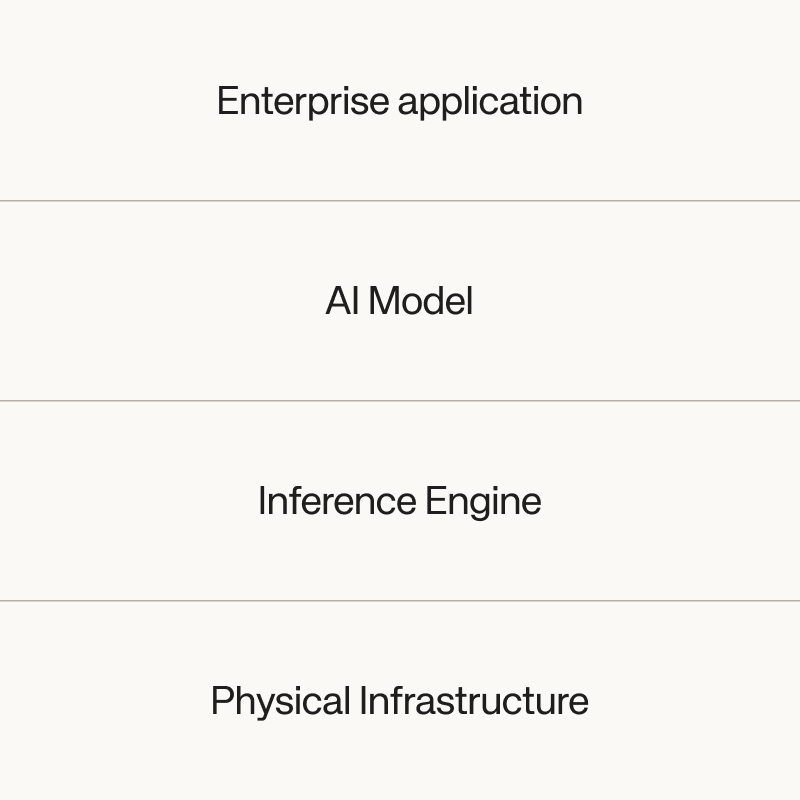
Together, these components determine how efficiently AI is delivered. While the model determines what responses are generated, the inference engine determines how efficiently those responses are produced, i.e., how quickly requests are processed, how many users can be served at once, and how much computing power is required. The physical infrastructure provides the computing resources that power AI workloads.
Inference optimization focuses on serving AI models faster, more reliably, and at lower cost. The inference engine relies on several techniques to improve efficiency:
- Smart Request Scheduling: Organizing and prioritizing incoming requests so short, simple tasks are processed quickly rather than waiting behind much larger or more complex workloads.
- Dynamic Batching: Processing multiple compatible requests together so expensive GPU resources spend more time working and less time sitting idle.
- Prompt and Context Caching: Reusing previously processed instructions or documents instead of repeating the same work for every request, reducing both response times and computing costs.
- Smart Memory Management: Allocating GPU memory more efficiently so each server can support more simultaneous users while maintaining fast, reliable performance.
These techniques serve different goals. Some primarily improve hardware utilization and reduce operating costs. Others focus on reducing latency, increasing capacity, or maintaining consistent performance as workloads grow. Modern inference platforms typically combine multiple techniques to optimize all of these objectives simultaneously.
Why Similar Models Have Different Operating Costs
When evaluating AI platforms, organizations often compare API pricing and model benchmarks. API pricing tells them how much a provider charges to use a model, while model benchmarks indicate how capable that model is. While both are important, neither reveals how efficiently the provider serves the model. That efficiency depends largely on the software responsible for delivering the model and the environment in which it runs.
When an inference engine runs on generic public cloud infrastructure, it cannot always make full use of the available hardware. As a result, expensive GPUs spend more time idle, reducing efficiency and requiring organizations to deploy more infrastructure to support the same workload. Companies are forced to buy or rent far more hardware than they actually need just to keep up with demand.
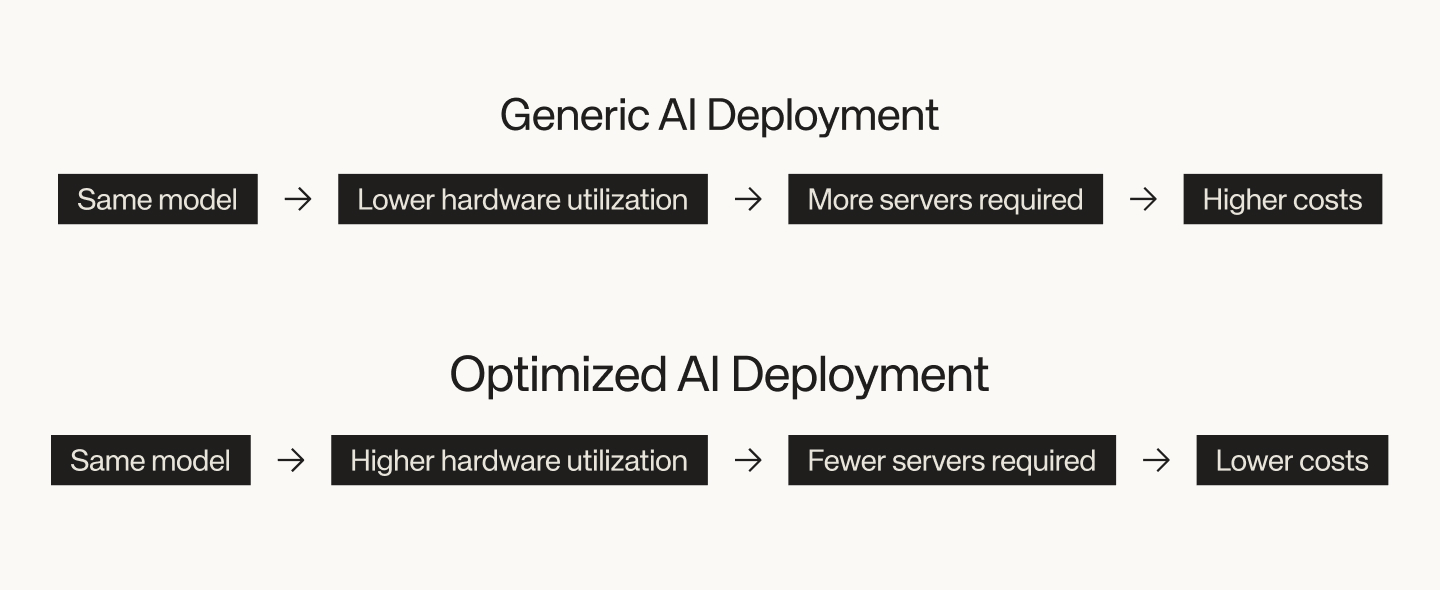
By contrast, when the delivery software and the underlying hardware are purpose-built to work together, hardware utilization stays high even as user traffic scales. The result is identical model capability delivered at a fraction of the operating cost.
Why Production Scale Changes the Equation
At low request volumes, such as small pilot projects or internal testing, inference inefficiencies are often difficult to notice. As AI moves into enterprise-wide production, however, those small inefficiencies become increasingly important. Organizations serving thousands of employees or millions of customer interactions each day amplify even modest improvements in efficiency.
Several business impacts begin to emerge.
- Idle Compute is Wasted Money: If your GPUs spend 50% of their time waiting for data transfers, half of your infrastructure bill is effectively wasted.
- Slow Responses Hurt Adoption: In multi-step AI workflows, minor delays on individual requests compound quickly into frustration, driving down employee adoption.
- Capacity Bottlenecks: Poor memory management limits how many people can use the system at the same time, forcing you to pay for extra servers prematurely.
At production scale, these effects reinforce one another. Small improvements in inference efficiency can translate into lower infrastructure costs, faster response times, and greater scalability across the entire AI deployment.
Looking Ahead: Software Meets Hardware
While inference optimization ensures the delivery software runs as efficiently as possible, software efficiency is ultimately bounded by the physical hardware underneath it. In Part 4: AI Delivery Infrastructure, we will look beneath the software layer to examine why physical compute architecture—chips, network wiring, and server design—has become a strategic differentiator in enterprise AI economics.
You can't prompt-engineer your way past a 200 Gbps network cap.

You can't prompt-engineer your way past a 200 Gbps network cap.